
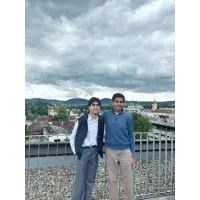
From June to July 2026, Agastya Sinha and Yash Chhugani joined the Department for Evidence-Based Medicine and Evaluation at the University for Continuing Education Krems as interns. During their time in Krems, both contributed to evidence synthesis projects, explored the potential of artificial intelligence in research.
Agastya Sinha studies Molecular and Cellular Biology and German at Johns Hopkins University in Baltimore, Maryland, USA. Alongside his studies, he works as an emergency medical technician and conducts immunology research at Johns Hopkins Medicine.
Yash Chhugani studies Neuroscience at Nova Southeastern University in Davie, Florida, USA. His academic programme also includes minors in Global Engagement, Public Health, and Honors Transdisciplinary Studies. With previous experience in neuroradiology and artificial intelligence at University Hospital Zurich and clinical exposure at Charité in Berlin, he brought an international perspective to his work at the Department.
Getting a feel for different areas of work with evidence
During his internship, Agastya contributed to several projects, including a rapid review on essential oils for pressure ulcer prevention and an ongoing scoping review exploring research priorities in pain-related health services for adults with rheumatological conditions. His work involved screening studies, extracting data, and conducting statistical analyses. He also gained experience in formulating research questions using the PICO framework and applying established methods for evidence synthesis with tools such as Covidence and DistillerSR.
Yash contributed to systematic, scoping, and rapid reviews across several fields, including rheumatology, infectious diseases, dermatology, and nursing. Working with international collaborators, including the European Centre for Disease Prevention and Control (ECDC) and Cochrane, he gained experience in study screening, full-text assessment, and data extraction. One of his key projects examined the burden of Streptococcus pneumoniae disease and asymptomatic carriage in high-income countries. He also explored AI-supported research tools such as Elicit.
Evidence-based medicine in practice
Agastya describes his internship as an opportunity to better understand the connection between basic research, clinical practice, and patient outcomes. His work in immunology focuses on biological mechanisms, while his role as an emergency medical technician brings him into direct contact with clinical practice. Evidence synthesis offered him a new perspective on the space in between: how scientific findings can be brought together to inform healthcare.
Yash particularly valued learning how scientific evidence is critically assessed and synthesized to inform healthcare decisions. His work with AI-supported research tools highlighted the potential of new technologies to improve efficiency, while also reinforcing the importance of human judgment, transparency, and methodological rigor.
“It also showed me how advances in artificial intelligence could help researchers work more efficiently, while reinforcing the need for human judgment, transparency, and methodological rigor.”
He also gained insights into responsible AI implementation in research through his involvement in interviews with faculty candidates on AI safety in health research. Looking ahead, Yash hopes to explore how neuroscience, healthcare innovation, and business can come together to translate scientific research and emerging technologies into meaningful improvements in patient care.
A new perspective on life in Austria
For Agastya, the supportive atmosphere at the Department was one of the most valuable aspects of the internship. He particularly appreciated the willingness of colleagues to share their expertise, help with challenging research decisions, and offer advice on making the most of his time in Krems.
“I felt very welcome in the Department, and I have so many people to thank for their mentorship.”
His memories of Austria also include its everyday rituals: enjoying a Wiener Melange and a Fruchtplunder, navigating public transport, attending a performance at the Burgtheater, and spending evenings at a Heuriger with friends.
One difference between Austria and the United States stood out to him: the pace of daily life. He was struck by the way people take time to enjoy a coffee rather than simply grabbing one on the go.
Yash also noticed a greater emphasis on work-life balance and appreciated the opportunity to explore local communities, public spaces, and other parts of Austria.